

Blog
What is CBT? A Beginner’s Guide to Cognitive Behavioral Therapy

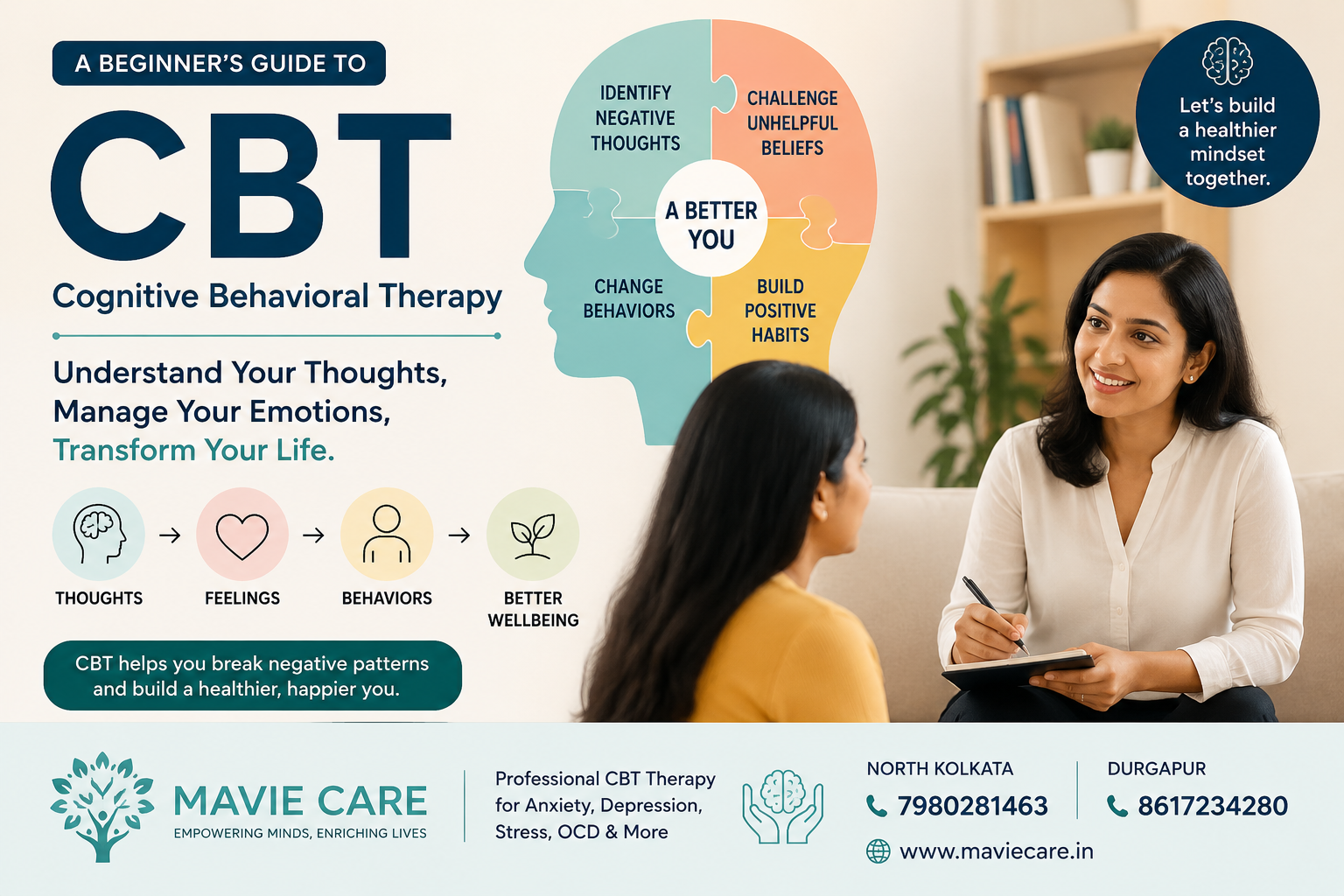
Mental health is becoming an increasingly important part of overall wellbeing. Just as we visit a doctor when we have a physical illness, seeking support from a mental health professional is equally important when we experience emotional difficulties, stress, anxiety, or depression.
Many people in Kolkata and across India are now becoming aware of different forms of psychological therapy. Among the various therapeutic approaches available today, Cognitive Behavioral Therapy (CBT) is considered one of the most effective, evidence-based, and widely recommended treatments for mental health concerns.
If you have been searching for CBT Therapy in Kolkata, you may be wondering:
- What exactly is CBT?
- How does CBT work?
- Can CBT help with anxiety or depression?
- Is CBT suitable for children and adults?
- What happens during a CBT session?
This beginner-friendly guide answers all these questions in simple language and provides real-life examples to help you understand how Cognitive Behavioral Therapy can improve your mental wellbeing.
What is Cognitive Behavioral Therapy (CBT)?
Cognitive Behavioral Therapy (CBT) is a structured form of psychotherapy that helps people identify and change unhelpful patterns of thinking and behavior that contribute to emotional distress.
The central idea behind CBT is simple:
“The way we think affects the way we feel, and the way we feel affects the way we behave.”
When people repeatedly experience negative thoughts, they may begin to feel anxious, depressed, stressed, or overwhelmed. Over time, these thoughts can influence their daily actions, relationships, work performance, and overall quality of life.
CBT helps individuals:
✔ Identify negative thought patterns
✔ Understand emotional triggers
✔ Challenge irrational beliefs
✔ Develop healthier thinking habits
✔ Improve coping skills
✔ Build emotional resilience
Unlike some therapies that focus heavily on past experiences, CBT primarily focuses on current challenges and practical solutions.
Understanding the CBT Model
CBT is often explained using a simple model involving three interconnected elements:
Thoughts → Feelings → Behaviors
Let’s understand this through a real-life example.
Situation
A working professional receives a message from their manager asking for an urgent meeting.
Thought
“I must have made a mistake. I’m going to get into trouble.”
Feeling
Anxiety, fear, nervousness.
Behavior
Difficulty concentrating, avoiding work, overthinking, loss of productivity.
In reality, the manager may simply want to discuss a new project or share positive feedback.
CBT helps the individual examine their assumptions and replace them with more balanced thoughts.
Alternative Thought
“There could be many reasons for this meeting. I should wait until I know the facts.”
Result
Reduced anxiety, improved confidence, and healthier behavior.
Why Do Negative Thoughts Occur?
Our brains are designed to protect us from danger. However, sometimes the mind becomes overly focused on potential threats, leading to distorted thinking patterns.
These distorted patterns are known as cognitive distortions.
Common Cognitive Distortions
1. Catastrophizing
Assuming the worst possible outcome.
Example:
“I failed one interview. I’ll never get a job.”
2. Mind Reading
Believing you know what others are thinking.
Example:
“They didn’t reply to my message. They must be upset with me.”
3. Overgeneralization
Drawing broad conclusions from a single event.
Example:
“I made a mistake today. I always fail.”
4. All-or-Nothing Thinking
Viewing situations in extremes.
Example:
“If I’m not perfect, I’m a complete failure.”
5. Personalization
Blaming yourself unnecessarily.
Example:
“My friend seems upset today. It must be because of something I did.”
CBT helps individuals recognize these thought patterns and replace them with realistic alternatives.
How Does CBT Work?
CBT is a collaborative process between the therapist and the client.
Rather than simply discussing problems, CBT focuses on understanding how thoughts, emotions, and behaviors interact.
Step 1: Assessment
The therapist gathers information about:
- Current challenges
- Emotional symptoms
- Daily functioning
- Personal goals
Step 2: Identifying Negative Thoughts
Clients learn to observe automatic thoughts that occur in stressful situations.
Step 3: Challenging Unhelpful Beliefs
The therapist helps evaluate whether these thoughts are supported by evidence.
Step 4: Replacing Distorted Thoughts
Negative beliefs are gradually replaced with balanced and realistic alternatives.
Step 5: Behavioral Change
Clients practice new coping strategies and behaviors.
Step 6: Building Long-Term Skills
The ultimate goal is to equip individuals with lifelong tools to manage future challenges independently.
Real-Life CBT Examples for Indian Readers
Understanding CBT becomes easier through everyday examples.
Example 1: Exam Anxiety
Riya, a Class 12 student, is preparing for her board examinations.
Every day she thinks:
“If I don’t score above 95%, my future is ruined.”
This thought creates immense pressure and anxiety.
She struggles to sleep and finds it difficult to concentrate.
CBT Intervention
Her therapist asks:
- Is one exam enough to determine your future?
- Do successful people always score above 95%?
- What evidence supports your belief?
Gradually, Riya develops a healthier perspective:
“Doing well is important, but one exam cannot define my entire future.”
As her anxiety decreases, her focus improves.
Example 2: Workplace Stress
Amit works in a corporate office in Kolkata.
Whenever he receives feedback from his manager, he immediately thinks:
“My boss thinks I’m incompetent.”
As a result, he becomes anxious and avoids communication.
CBT Intervention
The therapist encourages him to examine the evidence.
Questions include:
- Has your manager ever praised your work?
- Could feedback simply be part of professional growth?
Eventually, Amit recognizes that feedback is not personal criticism.
His confidence improves, and workplace stress decreases significantly.
Example 3: Social Anxiety
Priya avoids social gatherings because she fears people will judge her.
Before attending an event, she thinks:
“Everyone will notice my mistakes.”
CBT Intervention
The therapist helps her gradually attend small social situations and test her assumptions.
Over time, she realizes:
Most people are focused on themselves rather than judging others.
This realization helps reduce social anxiety.
Conditions CBT Can Help Treat
CBT is widely used to treat various mental health concerns.
Anxiety Disorders
Including:
- Generalized Anxiety Disorder (GAD)
- Social Anxiety
- Health Anxiety
- Panic Disorder
Depression
CBT helps identify negative beliefs that contribute to sadness, hopelessness, and low motivation.
Obsessive-Compulsive Disorder (OCD)
CBT, particularly Exposure and Response Prevention (ERP), is highly effective for OCD management.
Panic Attacks
Individuals learn strategies to manage physical symptoms and reduce fear of future attacks.
Phobias
Such as:
- Fear of heights
- Fear of public speaking
- Fear of flying
Stress Management
CBT helps people cope more effectively with work stress, academic pressure, and life challenges.
Low Self-Esteem
It addresses negative self-beliefs and promotes healthier self-perception.
Relationship Issues
CBT can improve communication skills, emotional regulation, and conflict resolution.
What Happens During a CBT Session?
Many first-time clients feel nervous before attending therapy.
Understanding the process can help reduce uncertainty.
Initial Consultation
The therapist discusses:
- Current concerns
- Personal experiences
- Therapy goals
Understanding Thought Patterns
You learn to identify situations that trigger emotional distress.
Learning CBT Techniques
These may include:
- Thought records
- Cognitive restructuring
- Relaxation exercises
- Behavioral experiments
- Problem-solving techniques
Homework Assignments
CBT often includes practical exercises between sessions.
Examples:
- Keeping a thought diary
- Practicing coping skills
- Completing worksheets
- Trying new behaviors
Homework helps reinforce learning and accelerate progress.
Benefits of Cognitive Behavioral Therapy
CBT offers several advantages.
Evidence-Based
Thousands of research studies support its effectiveness.
Practical
Focuses on real-life challenges and solutions.
Structured
Provides a clear roadmap for improvement.
Goal-Oriented
Progress can be measured and tracked.
Long-Term Benefits
Skills learned during therapy can be applied throughout life.
Common Myths About CBT
Myth 1: Therapy Is Only for Serious Mental Illness
Reality:
CBT can help anyone experiencing stress, anxiety, self-doubt, or emotional difficulties.
Myth 2: Talking About Problems Makes Them Worse
Reality:
Discussing challenges in a structured way often leads to better understanding and solutions.
Myth 3: CBT Changes Your Personality
Reality:
CBT helps individuals develop healthier thinking patterns while remaining true to themselves.
Myth 4: Therapy Takes Forever
Reality:
Many CBT treatment plans are relatively short-term and focused on specific goals.
Who Can Benefit from CBT?
CBT is suitable for people across different age groups.
Children
For:
- Anxiety
- Behavioral challenges
- Emotional regulation
Teenagers
For:
- Academic pressure
- Social anxiety
- Self-esteem concerns
College Students
For:
- Exam stress
- Career uncertainty
- Relationship issues
Working Professionals
For:
- Workplace stress
- Burnout
- Performance anxiety
Adults and Senior Citizens
For:
- Depression
- Anxiety
- Life transitions
- Emotional wellbeing
When Should You Seek CBT Therapy?
Consider professional support if:
- You constantly overthink situations.
- Anxiety interferes with daily activities.
- Stress affects your sleep or concentration.
- You experience frequent panic attacks.
- Negative thoughts feel overwhelming.
- Emotional challenges affect relationships or work.
- You find it difficult to cope with life changes.
Seeking help early often leads to better outcomes and prevents symptoms from becoming more severe.
Finding the Right CBT Therapist in Kolkata
Choosing a qualified mental health professional is an important step.
Look for:
✔ Qualified psychologists
✔ Experience with CBT techniques
✔ Evidence-based treatment approaches
✔ Comfortable and supportive environment
✔ Personalized therapy plans
A skilled therapist can help you understand your unique challenges and develop strategies tailored to your needs.
Why Choose Mavie Care for CBT Therapy in Kolkata?
At Mavie Care, we believe mental wellbeing is essential for a healthy and fulfilling life.
Our experienced psychologists provide evidence-based CBT Therapy in Kolkata for children, adolescents, adults, and families.
We help individuals manage:
- Anxiety
- Depression
- OCD
- Panic attacks
- Stress
- Phobias
- Relationship concerns
- Emotional difficulties
Our approach is compassionate, professional, and personalized to each individual’s needs.
Whether you’re struggling with overthinking, anxiety, low confidence, or emotional challenges, our team is here to support you every step of the way.
Final Thoughts
Mental health challenges can feel overwhelming, but you don’t have to face them alone.
Cognitive Behavioral Therapy (CBT) is one of the most effective tools available for understanding thoughts, managing emotions, and creating lasting positive change.
By learning to identify negative thinking patterns and develop healthier responses, individuals can build resilience, improve relationships, and enhance their overall quality of life.
If you’re looking for professional CBT Therapy in Kolkata, Mavie Care is here to help.
Book Your Consultation Today
Mavie Care
📍 North Kolkata | Central Kolkata | Durgapur
📞 Kolkata: 7980281463
📞 Durgapur: 8617234280
🌐 https://maviecare.in
Take the first step towards better mental wellbeing today.